


Industrial embedded file system requirements
An industrial embedded file system must provide more than basic file access. This guide explains how to define measurable requirements...
We are here to help
Have a question or need guidance? Whether you’re searching for resources or want to connect with an expert, we’ve got you covered. Use the search bar on the right to find what you need.


Experts often discuss functional safety using standards, audits, and certification milestones. What is much less discussed is the very real, long-term resource commitment that developing and maintaining a safety-certifiable TCP/IP stack or a file system requires.
When we look at the actual resource breakdown required for functional safety development, one thing becomes immediately clear: this is not a small extension of standard software development; it is a fundamentally different operating model.
Many industries, such as automotive, medical, industrial, railway, aerospace, and defense, manage and handle devices considered mission-critical.
These devices need to have a safe mode of operation, and in case of a functional error, there needs to be a way to stop the function safely. For example, industrial robotics prevents the robot from starting if an error or fault occurs.
From a software development perspective, we could look at one example. Consider a safety-certifiable TCP/IP stack (with basic components of IPv4, ICMPv4, IGMPv2, TCP, UDP, DHCPv4, and BSD Sockets) that must be developed according to strict standards such as ISO 26262, IEC61508, or any other functional safety standard, ensuring vertical and horizontal traceability from system and software safety requirements, down to architecture and unit design, implementation and up to verification and validation results.
To achieve this, organizations typically need to allocate resources across several distinct roles:
1. Dedicated functional safety development team
Handling functional safety as a side task is not an option. In the example project of a TCP/IP, the effort for the basic functionality is 4-5 full-time engineers for at least 2 years focused exclusively on safety-related development activities. In this example, we consider the basic functionality (modules listed earlier) of the TCP/IP, not more advanced features.
The development team must handle the following:
These engineers must gain experience in functional safety or undergo extensive training before they can make any meaningful progress.
2. Independent safety and quality team
Besides the development team, functional safety standards require independence in assessment and oversight. This usually translates to 1-2 full-time specialists in this example project where we are developing a basic TCP/IP stack for functional safety dedicated to:
This team operates independently from development, adding another permanent layer of resourcing.
3. Long-term maintenance commitment
Functional safety does not end at certification. In the example project, throughout the product’s lifetime, the TCP/IP stack is to be maintained in a safety-compliant manner. Although rare, the potential need for bug fixes or other changes means that the overall impact of the change should be assessed throughout the whole V-model. This assessment includes requirements, design, implementation, verification and validation, and FMEA. Adjustments need to be applied if necessary. This requires attention and diligence throughout the product’s lifecycle in case changes are necessary.
Taken together, the resource requirements show why functional safety projects often experience:
This is particularly challenging for teams attempting to adapt open-source networking stacks or build an in-house solution. In practice, achieving safety compliance often means redeveloping large portions of the stack while still carrying the full burden of safety processes, audits, and lifetime maintenance.
Tuxera TCP/IP CERT and EdgeFS CERT specifically address this challenge.
By providing a pre-developed, safety-focused TCP/IP stack or a file system with certification-ready artifacts, Tuxera removes much of the resource burden described above by:
In the example project of the TCP/IP, this results in:
The resource requirements summarized below tell an important story: functional safety is not just a technical challenge — it is a strategic resourcing decision.
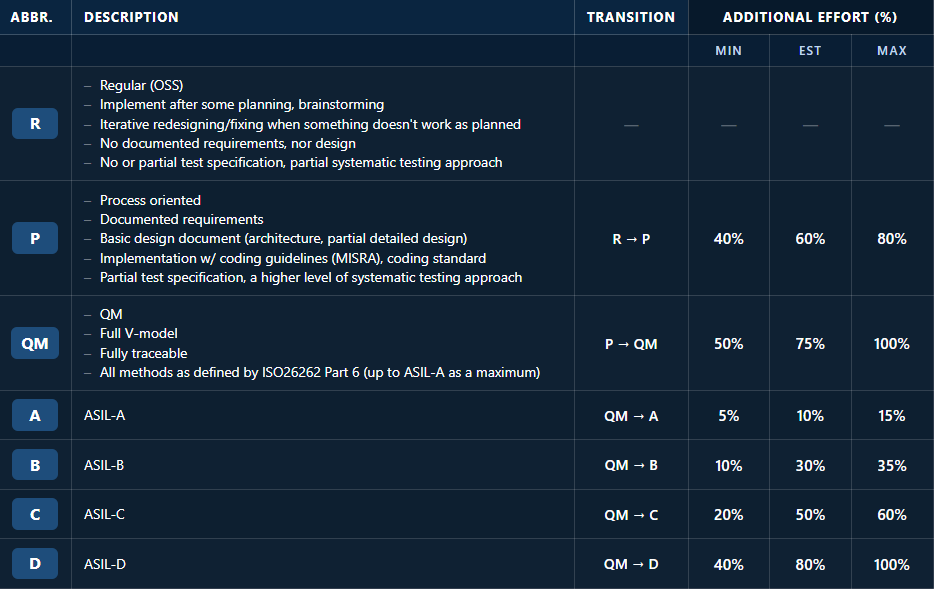
In the table above, the lower percentage represents a best-case scenario with a team that is already experienced in functional safety development, the maximum effort increase is with a team that has not been working with functional safety before. The information source is Kugler Maag and the Tuxera in-house team. We always compare the effort increase to the previous step.
Organizations that account for this early enough can avoid surprises, delays, and cost overruns. With Tuxera TCP/IP CERT or EdgeFS CERT, teams gain predictability: predictable effort, predictable timelines, and predictable long-term costs, without compromising on safety.
Discover how Tuxera's certified software components can reduce your functional safety resource burden.RELATED ARTICLES

An industrial embedded file system must provide more than basic file access. This guide explains how to define measurable requirements...

In software-defined vehicles, zonal architecture storage requirements are requirements for predictable behavior under stress rather than peak speed. What changes...

Tuxera has successfully renewed its ISO 9001:2015 certification, reaffirming the strength and consistency of our global quality management system for...

Tuxera, the award-winning global leader in quality-assured file systems and storage management solutions, is expanding its reach in Korea with Ocube taking...
Suggested content for: