


Fusion SMB instead of Samba: Why?
Samba, the open-source SMB server for Linux, is free. Ned Pyle sets out why enterprises still pay for Fusion SMB,...
We are here to help
Have a question or need guidance? Whether you’re searching for resources or want to connect with an expert, we’ve got you covered. Use the search bar on the right to find what you need.

Windows and macOS have never stopped relying on SMB. Roaming profiles, home folders, redirected folders, mapped drives, centralized application settings: all of it moves over SMB. That has not changed as organizations have shifted their infrastructure to the cloud, and it is not going to. So as cloud service providers build out file services for enterprise customers, the protocol question is not going away. AWS, Microsoft, and Google have all shipped SMB-backed services for exactly this reason, and each of them has effectively said the same thing: to serve Windows and macOS clients properly, you need SMB, and you need it to be reliable at scale.
The catch is that SMB is genuinely hard to get right in a multi-tenant, highly available cloud environment. It is easy to set up a basic file share. It is much harder to guarantee data integrity under load and survive node failures without interrupting active sessions. That gap is where the opportunity, and the risk, sits for CSPs building these services.
Here are four workloads where SMB support creates a clear opportunity, and what separates a production-grade SMB implementation like Tuxera Fusion from a do-it-yourself Samba deployment.
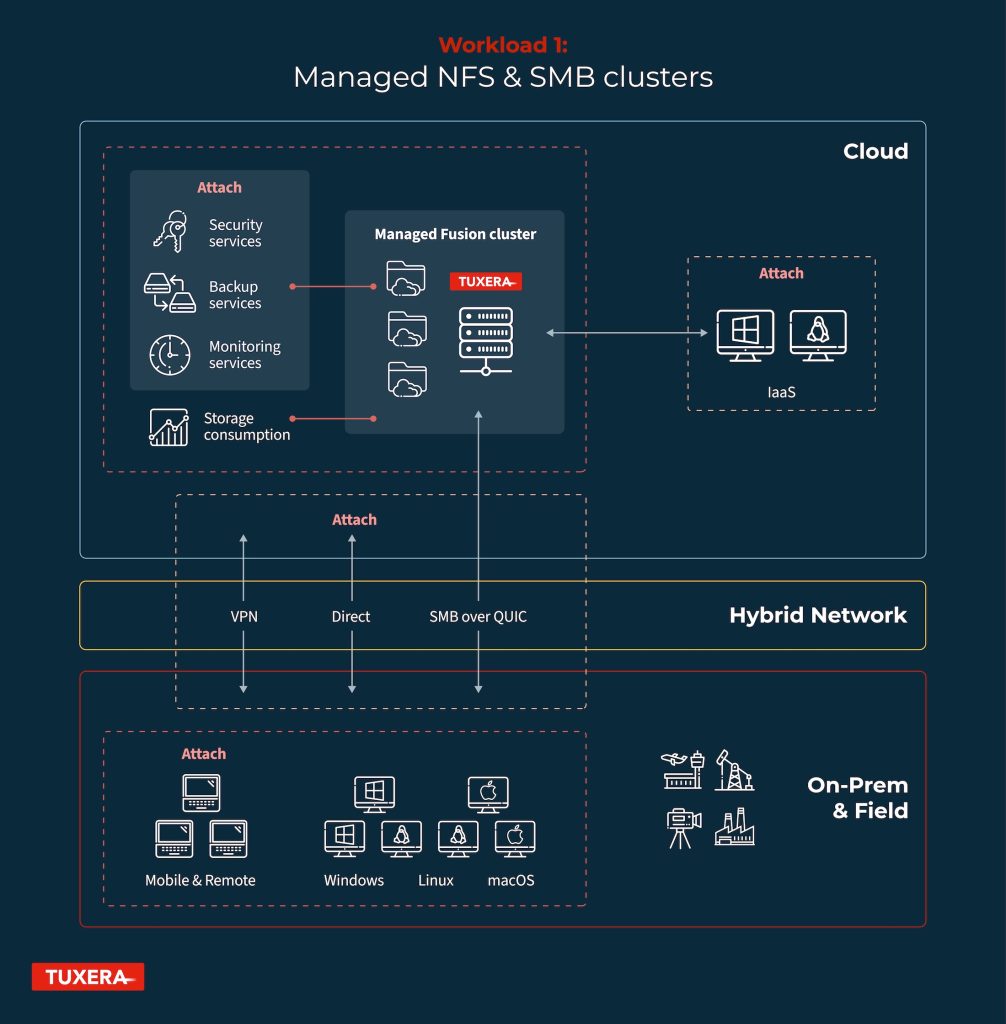
This is the highly available, scale-out file server offered as a managed service. Customers get enterprise file serving for Windows and macOS clients without babysitting a file server themselves, whether those clients sit on-premises, in a hybrid setup, or run as VMs in the cloud.
Offering this as a managed service, rather than pointing customers at a bare IaaS file server they have to configure and scale themselves, is real, monetizable value on top of infrastructure that would otherwise commoditize.
What matters at the implementation layer: data integrity (Direct I/O guarantees writes land correctly, instead of relying on caches that can corrupt data under failure), high availability (active-active scale-out with persistent handles and transparent failover, so a node failure does not interrupt service), and cost efficiency (modern multi-threading instead of a per-client process model means better density on the same hardware, and better margins for the provider). In published benchmarks, Fusion SMB delivered over 10x the read throughput of Samba on 200GbE on identical hardware, and closer to 20x on 400GbE.* In heavy access workloads, it used up to 90% less CPU and 92% less memory,** which translates directly into that density advantage.
File systems play a large role in network delivery. Fusion’s VFS layer directly interfaces and optimises the throughput. For example, using Fusion over a CEPH filesystem delivers 14.8 GB/s vs 1.67 GB/s for Samba.
Contracted support with a real SLA matters too, especially at enterprise scale, where customers expect a committed response time rather than a community forum.
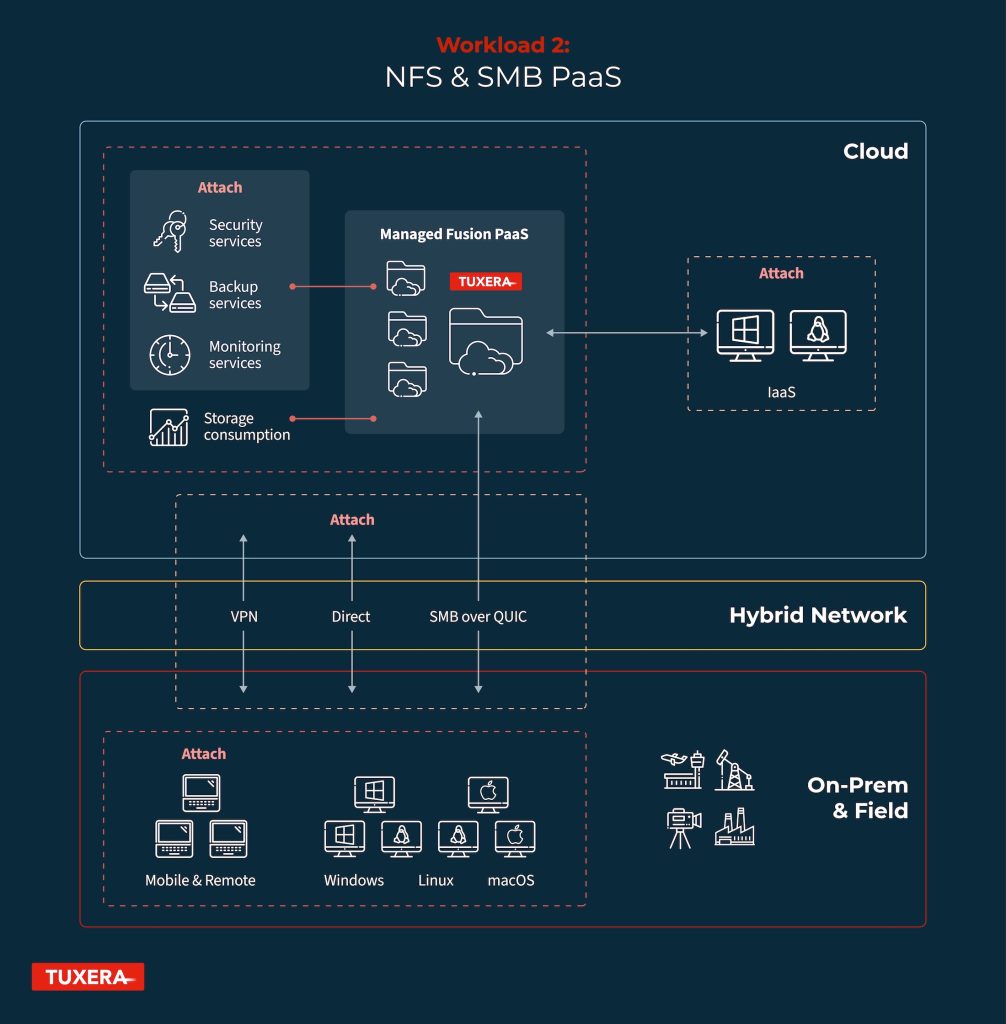
This is the fully native, cloud-service version of SMB, where the file server itself disappears into the platform. Customers get highly scalable file serving for Windows and macOS without provisioning or managing any server at all.
Beyond the same data integrity and high-availability requirements as managed clusters, PaaS-grade SMB needs to handle demanding workloads gracefully and elastically, since customers expect the service to scale with them rather than requiring a re-architecture at some threshold. RDMA networking support, for instance, is what makes SMB viable for HPC-adjacent use cases such as AI data ingestion pipelines and media and entertainment production, running natively in the cloud rather than being routed around it.
Fusion SMB is the production-grade SMB layer behind hyperscaler file services, engineered for data integrity, transparent failover, and multithreaded density.
Explore Tuxera Fusion SMB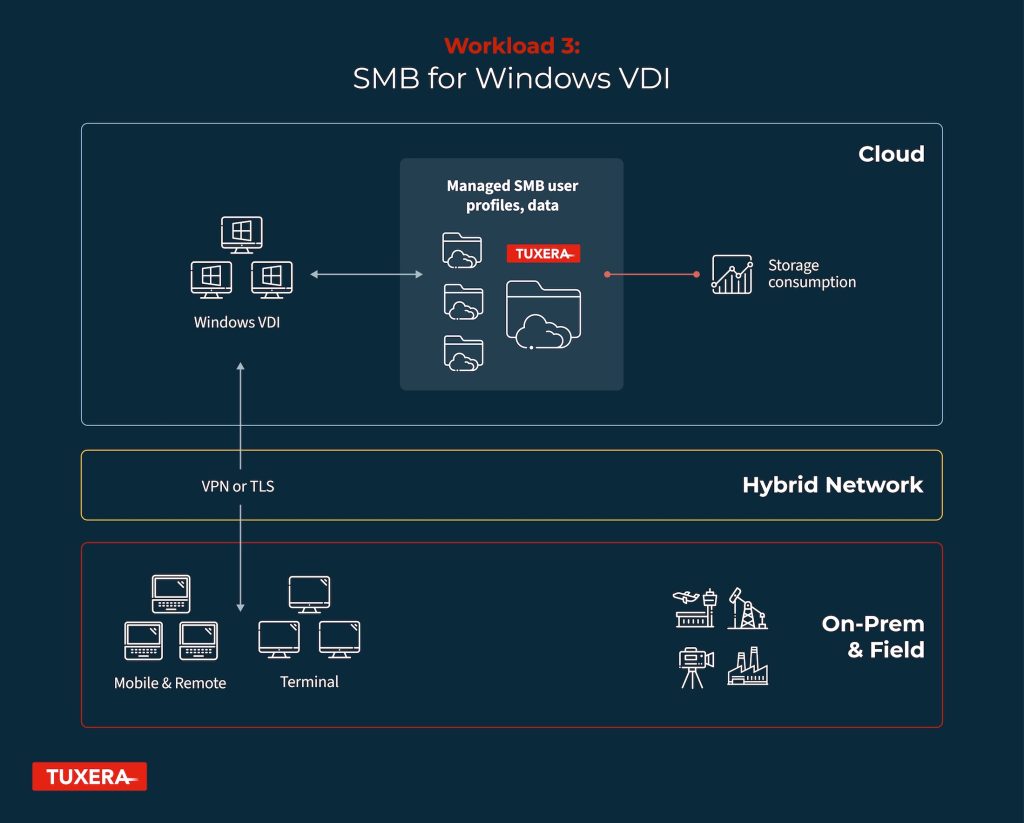
Virtual desktop infrastructure has a structural problem: the VM is ephemeral, but the user’s settings, roaming profile, and data are not supposed to be. Every time a session ends, the underlying machine can disappear, and the next login needs to feel like picking up exactly where the user left off.
It is worth noting that there is no NFS alternative here. SMB is the only option, which makes the quality of the SMB implementation directly load-bearing for the VDI experience. Persistent handles and transparent fail-over prevent a node hiccup from disrupting an active desktop session, and SMB over QUIC adds another layer of security that increases value at the edges of that picture: for remote and mobile VDI clients connecting in over the open internet before their traffic ever reaches the tenant’s own network boundary.
This one is easy to overlook: a CSP is also just an IT organization. Its own employees run Windows and macOS desktops and need file servers for the same reasons any enterprise does, including shared drives, home directories, and centrally managed settings. And behind the scenes, cloud platforms move enormous volumes of data for infrastructure purposes, such as staging and shuttling data behind VM operations, distributing golden images to hypervisor hosts, and collecting logs and telemetry from fleet machines.
SMB is the only protocol that works natively and at speed across Windows, macOS, and Linux, which makes it the practical choice for this kind of internal infrastructure workload, with the same requirements for compression, scale-out clustering, and fail-over that show up everywhere else on this list. It is a less visible workload, but the operational cost of getting it wrong internally is just as real.
Across all four workloads, the pattern repeats: Windows and macOS clients need SMB, and the quality of the SMB layer, meaning its data integrity guarantees, its availability under failure, its performance density, and the support behind it, determines whether that workload becomes a differentiated, margin-positive service or a support burden that quietly erodes the business case.
Tuxera Fusion SMB is designed to close that gap, handling CSP production workloads offering throughput, efficiency, security, and scale.
Weighing how to serve Windows and macOS file workloads on your platform? Talk to the team behind the SMB implementation running at hyperscaler scale.
Talk to our expertsRELATED ARTICLES

Samba, the open-source SMB server for Linux, is free. Ned Pyle sets out why enterprises still pay for Fusion SMB,...

Ned Pyle compares Fusion SMB, a Linux SMB server, with Windows Server on scale, clustering, performance, and security, using side-by-side...

Fusion SMB, Tuxera’s Linux SMB server, read at 46.86 GB/s where Samba, the open-source SMB server for Linux, managed 4.17...

When AI platforms underperform in production, most teams reach for more GPUs. But the real bottleneck is often the storage...
Suggested content for: