Enterprise-grade file sharing for Linux-based storage
One file server. SMB and NFS, from the same engine.
Fusion brings a decade of enterprise expertise as a commercial, globally supported alternative to Samba, the open-source SMB server for Linux, and to the open-source NFS servers NFSD and NFS-Ganesha.
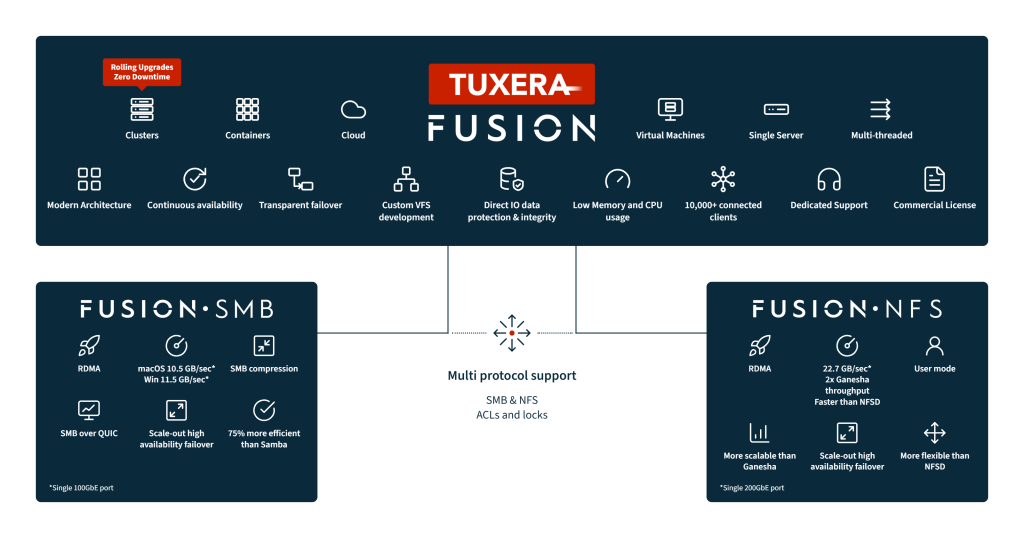
Fusion is Tuxera’s enterprise file-serving platform. Fusion SMB and Fusion NFS share one user-space core, so Windows, macOS and Linux clients reach the same data with shared locking, shared permissions and the performance to keep GPUs busy.
Trusted by industry leaders
Multiprotocol
SMB and NFS on the same data, safely
Most multiprotocol NAS bolts two separate servers onto one file system and hopes they agree. Fusion SMB and Fusion NFS run on one core, so a Windows editor and a Linux render node see the same file, the same lock and the same permissions.
Central locks and handles
One lock and handle control mechanism for both protocols. An SMB open is visible to NFS clients and the other way round, so no one overwrites a file someone else is working on.
Shared ACL management
Windows ACLs and NFSv4 ACLs are managed and stored centrally, alongside POSIX permissions. Set access once; it applies whichever protocol a client uses.
Share data transparently
Mixed Windows, macOS and Linux teams work on one dataset without copies, sync jobs or permission drift between protocols.
Scale out
Fusion clusters run with every node active, adding performance as you add nodes. Clients fail over transparently, and rolling upgrades mean software updates without a maintenance window.
One architecture under both protocols
Fusion runs entirely in user space above an OS abstraction layer. Services such as authentication, change notification and metrics talk over IPC to the protocol engine, which handles VFS, transport, crypto and compression.
About 85% of the code is shared between Fusion SMB and Fusion NFS. A fix or optimisation in the core lands in both, and multiprotocol behaviour is designed in rather than added on. Fusion runs on Intel, AMD, Arm and PowerPC.
Frequently asked Questions
Why choose Fusion?
Get answers to the most commonly asked questions, or reach out if your question isn’t listed here.
Tuxera Fusion is an enterprise file-serving platform for Linux-based storage. It includes Fusion SMB and Fusion NFS, which run on the same user-space core, so Windows, macOS and Linux clients can work on the same data with shared locking and permissions.
Fusion SMB serves clients over SMB, the protocol Windows and macOS use, and Fusion NFS serves clients over NFS, which is common on Linux and in HPC. About 85% of the code is shared between them, so both get the same performance work, identity integration and scale-out features. Each can run on its own, or both can run together in the same cluster.
Yes. Locks and open handles are controlled centrally for both protocols, so an SMB open is visible to NFS clients and the other way round. Windows ACLs, NFSv4 ACLs and POSIX permissions are stored together, and access you set once applies whichever protocol a client uses.
Fusion is a commercial alternative to these open-source servers, with commercial support and SLAs in place of community best-effort. It also offers shared locking and permissions across SMB and NFS, scale-out clusters with transparent failover, and rolling upgrades with zero downtime. Under the same load, Fusion SMB uses 79% less CPU and 93% less memory than Samba.
Yes. Fusion supports RDMA, SMB multichannel and NFS client trunking. In MLPerf Storage 2.0 3D U-Net training over 200GbE, Fusion SMB kept 15 H100 accelerators above 90% utilization and Fusion NFS kept 12, against 9 for kernel NFSD on the same hardware.
Fusion connects to storage through its VFS module. Tuxera has native integrations for WekaFS, IBM Storage Scale (GPFS), DAOS and CephFS, and Fusion also works with POSIX file systems including Quantum Myriad, Lustre, GlusterFS, GFS2, OCFS2, ext4, ZFS and XFS. Partners can commission custom VFS modules for other file systems.
Fusion clusters run with all nodes active, and performance grows as you add nodes. If a node fails, clients fail over transparently using persistent handles. Rolling upgrades update the software across the cluster with zero downtime, so there is no maintenance window.
Yes. Because Fusion runs in user space, it can be deployed in containers with user-mode multi-tenancy and high density per server. It runs on your own hardware, on Intel, AMD, Arm or PowerPC.
For identity, Fusion integrates with Active Directory, OpenLDAP and Apple Open Directory. Authentication supports Kerberos, NTLM, IAKerb and a local KDC. SMB encryption supports AES-128-CCM, AES-128-GCM, AES-256-CCM and AES-256-GCM.
Storage manufacturers and cloud providers building on Linux-based storage. They integrate Fusion instead of developing their own SMB and NFS servers, and can request features for their own roadmap. Tuxera has shipped enterprise SMB to storage partners since 2016.

Cloud service providers
Choose our highly scalable, low overhead, container-based file server. Increase tenant density, while decreasing compute resources.
Learn more

Data platform providers
Unleash the full potential of your platform's capabilities with the world's fastest SMB solution.
Learn more

Media & entertainment
Handle massive 4K, 8K, and 16K video files across Mac, Windows, and Linux at speeds other solutions can't match.
Learn more

Medical & healthcare
Spend less time waiting for progress bars and more time innovating and making breakthroughs.
Learn more

System integrators
Get the secure, scalable, compatible solution, with the most flexibility, without compromising on capabilities.
Learn more
Connect with Tuxera
Fusion resellers and integration partners worldwide
Writing an enterprise file server takes years of protocol work, and most storage companies would rather spend that time on their own product. Tuxera Fusion gives partners Linux file servers that drop into their stack as a single binary and integrate natively with their file system. Fusion SMB, our Linux SMB server, and Fusion NFS are built on the same core, so partners can offer SMB and NFS from one platform.
RELATED RESOURCES
More resources for inspiration

Why better SMB performance is key to speeding up data transfers
Learn more
Fusion File Share by Tuxera failover and recovery in Kubernetes
Learn more
Improving file server reliability using SMB transparent failover with continuous availability
Learn more

Default or community SMB implementations can be entirely adequate for many customer environments. This guide explains when performance targets, mixed-client interoperability, high availability, security changes, licensing, lifecycle maintenance, and escalation…

Tuxera and IDEATEC have signed a strategic partnership to build a joint Data-to-Action model for enterprise AI. Fusion SMB provides the file data access layer, IDEATEC’s AX iPaaS turns AI…

An enterprise SMB server solution should be evaluated as part of the complete customer storage architecture. This deployment checklist covers workload requirements, protocol and client compatibility, Active Directory and access…
Windows and macOS have never stopped relying on SMB, and cloud platforms have not either. Four workloads where SMB support creates a clear opportunity for cloud service providers, and what…

A fast NAS cannot be sized from one file-copy result. This guide explains how to benchmark SMB performance using representative workloads, client concurrency, sustained throughput, latency, CPU and network utilization,…

Most enterprise storage runs on two protocols, SMB and NFS, kept apart for decades because neither knows about the other’s locks or permissions. Tuxera Fusion brings both onto one platform…
Fusion SMB, Tuxera’s Linux SMB server, read at 46.86 GB/s where Samba, the open-source SMB server for Linux, managed 4.17 GB/s on identical hardware. A short tour of the MLPerf,…

Faster NVMe and high-speed Ethernet do not guarantee faster file access. This guide explains how workload shape, client concurrency, protocol processing, CPU usage, network behavior, security, and caching can make…
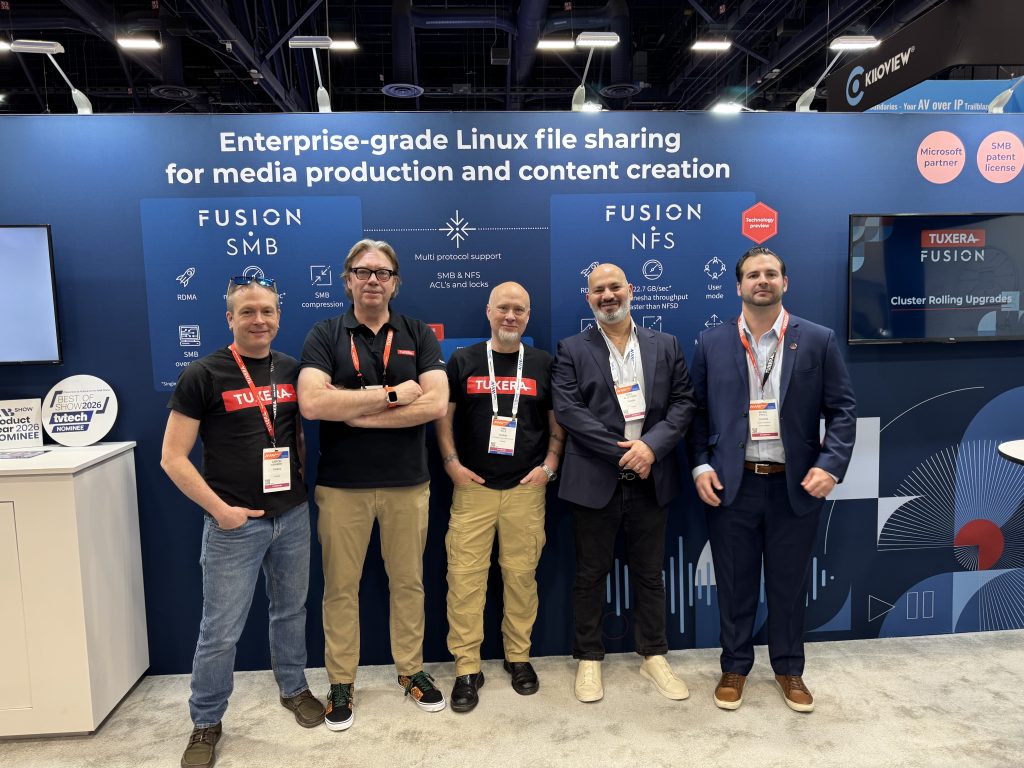
Quieter aisles, sharper conversations. Duncan Beattie on why NAB 2026 was Tuxera’s best show yet — and the performance numbers that made a year-old benchmark look quaint: 10.5 GB/s to…
When AI platforms underperform in production, most teams reach for more GPUs. But the real bottleneck is often the storage layer ; how data reaches compute, not compute itself. Shared…

Tuxera is showcasing breakthrough file sharing performance at NAB Show, highlighting its Fusion SMB platform and a technology preview of Fusion NFS. With speeds reaching 40 GB/s via Windows SMB…

Modern broadcast security must move beyond perimeter defenses, embedding encrypted workflows, zero trust principles, and resilient transport directly into distributed production infrastructure.