


Zonal architecture storage requirements: what to validate before you trust your SDV
In software-defined vehicles, zonal architecture storage requirements are requirements for predictable behavior under stress rather than peak speed. What changes...
We are here to help
Have a question or need guidance? Whether you’re searching for resources or want to connect with an expert, we’ve got you covered. Use the search bar on the right to find what you need.


Every over-the-air update has to do four things, and only one of them is “install the new software.”
It has to stage the incoming version somewhere the running system is not using. It has to verify that what arrived is authentic and complete. It has to apply it. And if activation goes wrong, like for example a power cut mid-write, or a kernel that boots but never reaches the application layer, it has to get back to a version that works, without a vehicle going back to a dealer or a technician driving out to a substation.
In this post, I want to compare the two approaches we see most often for that last requirement. A/B partitioning solves it with space: keep a second complete copy. Snapshot-based updating solves it with references: maintain the record of old state and only write what changed. Both approaches work. They lead to quite different platforms, and in our experience, the difference grows every time the software image does.
I should say up front I work on SnapFS, Tuxera’s snapshot-based file system, so I have a view. I have tried to be fair to A/B here, because it earned its place and I think it still belongs in certain architectures. More on that at the end.
A/B partitioning keeps a copy of the software in two identical slots. One is active and running. The other is idle, and the update writes into it while the running system stays untouched.
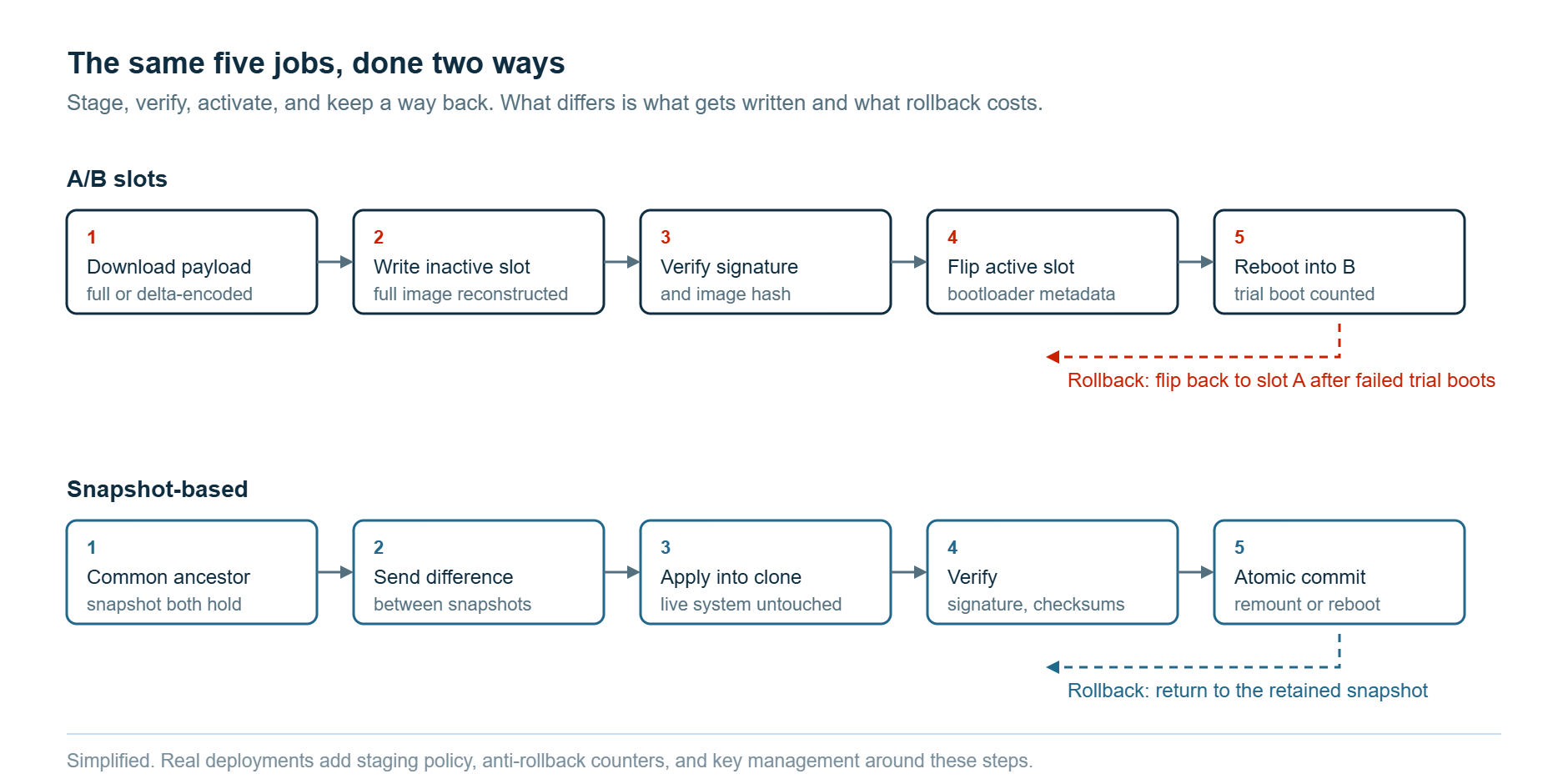
The strength of this design is how little it trusts. The rollback decision lives in the bootloader, below the operating system, so it survives almost any failure above it, including a kernel that panics before userspace starts. The two slots never interact, so there is no shared state to corrupt. Even though there is no shared state to corrupt, a hardware failure can still cause both states to fail, as the update sits on the same flash. For a safety case, that independence of both states is easy to argue and easy to test: cut the power at any point in the sequence and enumerate the outcomes. That is why A/B became the default on many vehicle platforms.
The cost is structural. Every component covered by the scheme is stored twice, permanently, whether or not an update is in progress.
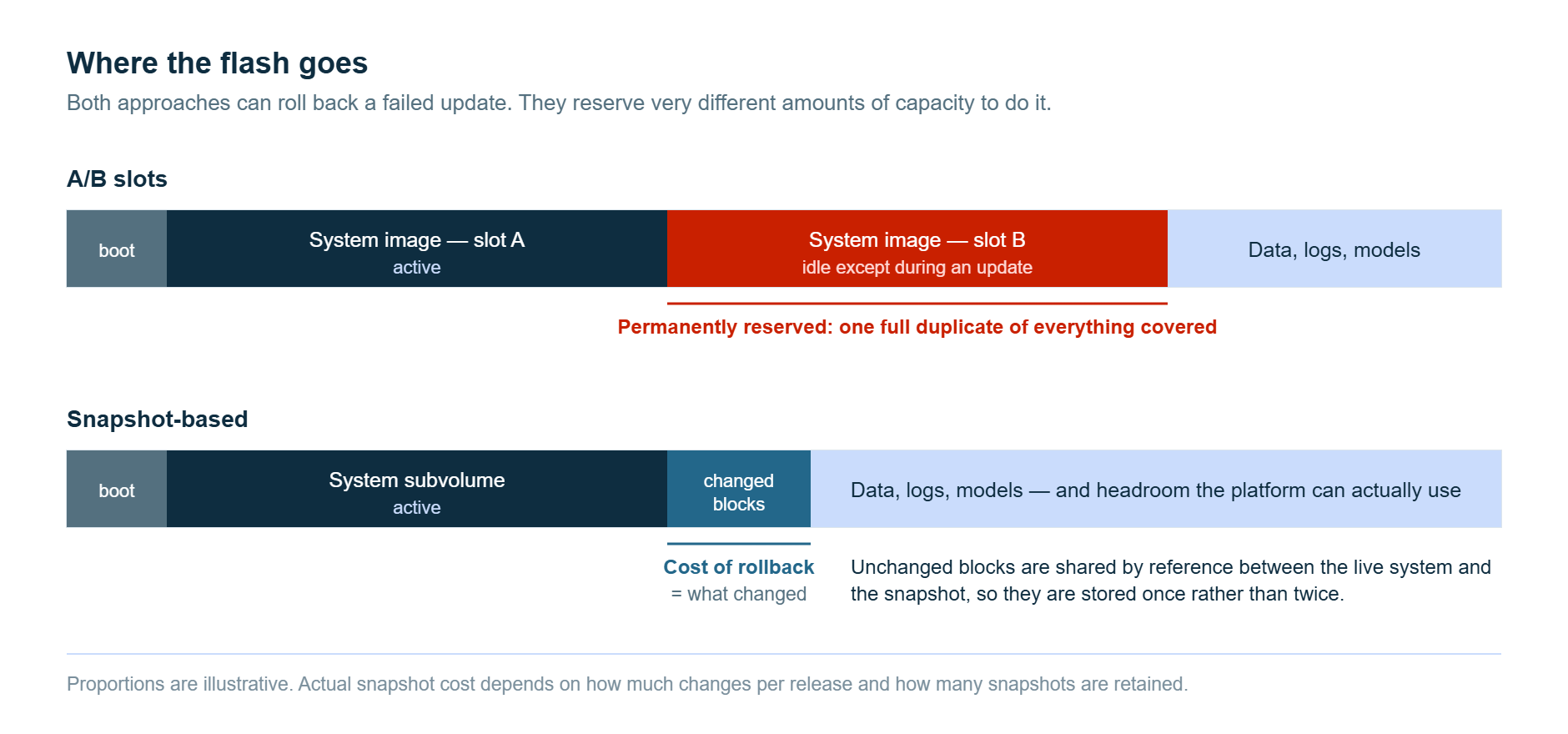
On a platform where the system image is a meaningful share of total flash, the second slot is capacity that is needed only a few minutes every few months. Three things follow:
None of this makes A/B a wrong approach. It makes it expensive in a specific, measurable way, and that cost is what sent us looking for an alternative.
A snapshot-based approach moves the rollback guarantee out of a duplicated region and into the file system itself, using copy-on-write.
Implementations differ, so rather than describe an average I will describe how SnapFS does it. Btrfs and Android’s Virtual A/B solve the same problem in their own ways. This is one way to do it, not the only one.
In a copy-on-write file system, modifying a block never overwrites it. The new version is written to free space, and the metadata is updated to point at it. A snapshot uses this: it records the current root of a subvolume, and from that moment the blocks that root references are frozen. Anything the running system changes afterwards is written elsewhere. Blocks nobody touched are shared by the snapshot and the live system, stored once and visible from both.
The second building block is the writable clone, a snapshot you can write into. A clone shares all its storage with the snapshot it came from and only consumes space where it diverges.
An update then looks like this:
The health check that decides whether the new version is good is the same kind of logic as in A/B, and it belongs to the update agent rather than the file system. What changes is what rollback costs once that check fails. The prior state is still a snapshot, so returning to it takes the same time whether the subvolume holds 200 megabytes or 20 gigabytes: no restore, no data movement, no second copy to fall back on, because the original blocks were never overwritten.
The storage cost is what changed, plus bookkeeping, plus however many older snapshots you keep. Not the size of the system. In SnapFS, the bookkeeping cost is small, and it is designed so that keeping snapshots does not slow down normal writes.
I want to be as direct about our side as I have been about A/B, because the trade-offs are real and they show up during integration rather than on a datasheet.
Update space comes from a shared pool. With A/B, the space for an update is reserved at design time and nothing else can consume it. With snapshots, the incoming update draws from the same free space as everything else, so update headroom becomes a runtime property rather than a fixed allocation. The question I would ask of any file system in this role is what happens when that space runs out mid-update. The operations that free space, such as deleting a snapshot, rolling back, or deleting a file, should still succeed on a completely full volume, because those are exactly the operations you need when an update has gone wrong. We designed SnapFS to guarantee that. Not every copy-on-write file system does, so it is worth asking rather than assuming.
Retention is a policy, not a habit. Every snapshot you keep pins the blocks it references. Keep ten releases and you may be holding a large share of the pool without meaning to. Snapshot lifetime needs an owner and a written rule.
Reclaiming space is deferred work. Deleting a snapshot or rolling back returns immediately, but the blocks it pinned are freed by garbage collection afterwards. That work can be postponed until free space runs low, and it is bounded rather than open-ended, but it is real work and it belongs in the platform’s timing and capacity budget rather than being discovered in the field.
Flash wear tends to go the other way. An A/B update writes a full image every release; a snapshot-based update writes only what changed. Copy-on-write also never overwrites in place, so the device sees mostly fresh, append-like writes, which is the pattern a flash translation layer handles with the least internal write amplification of its own. How large the effect is depends on the FTL in the part you have qualified, so I would treat this as a direction rather than a number.
The rollback domain is narrower than the bootloader’s. A snapshot protects file system state. It does not roll back the bootloader, MCU firmware elsewhere in the system, or anti-rollback counters that deliberately block a return to a version with a known vulnerability. If the failure is below the file system, the file system cannot recover it.
That last point, more than any other, shapes the architecture I would recommend.
| A/B slots | Snapshot-based | |
|---|---|---|
| Rollback decision made by | Bootloader, below the OS | Bootloader selects the snapshot to mount |
| Permanent storage reserved | One full duplicate of covered components | Bookkeeping plus retained snapshots |
| Where the update is staged | The idle slot | Temporary clone with common ancestor |
| Data written per update | Full or large image | Changed blocks only |
| Download size | Full or delta, depending on tooling | Delta between two snapshots |
| Recovers from a kernel that will not boot | Yes | Yes |
| Recovers from a corrupted application update | Yes | Yes |
| Space for the update | Fixed, reserved at design time | Shared pool, bounded by quotas |
| Effect of image growth | Duplicated volume grows with it | Delta size may grow with the change, not the image |
| Failure independence | Two regions share the same hardware; a hardware malfunction can render both regions useless | Shared pool and shared metadata |
| Validation effort | Well-trodden, simple state space | More states to characterize, especially near-full |
They are strong in different places. A/B is strongest at the bottom of the stack, where independence matters most and the thing being protected is small. On smaller ECUs or devices like meters, A/B is a large part of the cost of the device. Snapshots are strongest higher up, where payloads are large and change incrementally.
On most modern platforms I do not think this is a choice between the two. It is a split:
That split gives you bootloader-level protection against an unbootable device without paying to duplicate the parts of the image that are actually big. It also tends to match how teams already think about the platform: the recovery-critical core is a different kind of thing from the software that ships new features every quarter.
If you are weighing this on a real platform, I would want numbers for four things, ideally from field data rather than the design spec:
These four are the inputs to any savings estimate, and I would rather give you the method than a headline number. We can help bound them for a specific platform, but a figure quoted without a platform attached is not one I would trust either.
Update strategy and storage architecture are often designed by different people at different times, and that is how platforms end up with a rollback mechanism they cannot afford and headroom they cannot reach. Deciding them together is most of the work.
SnapFS is the file system I work on at Tuxera, and the snapshot mechanism above is how it approaches this problem: snapshots and writable clones for staging, incremental send and receive so an update moves only what changed, and rollback that costs a constant-time operation rather than a duplicated partition. It is built for the constraints these platforms impose: a fixed RAM budget set at configuration time, no dynamic allocation, no recursion, and one on-disk format across Linux, QNX, INTEGRITY, VxWorks and others.
If you are working through this trade-off on a real platform, I would like to compare notes ([email protected]).
If the split I describe above matches your platform, the file system side of it is SnapFS.
RELATED ARTICLES

In software-defined vehicles, zonal architecture storage requirements are requirements for predictable behavior under stress rather than peak speed. What changes...

Data corruption in software-defined vehicles does not always cause a crash. Why data reliability is now a strategic concern for...

OTA updates rewrite critical vehicle state under real-world stress. Learn the storage failure modes that brick units, and a power-cut...

A practical checklist for designing dashcam and DVR platforms that survive power loss, sustain multi-stream recording, and extend SD card...
Suggested content for: